
Calendar
LOGO Calendar 2026 – May: Simone Biles
Simone Biles, widely regarded as one of the greatest gymnasts of all time, is the most decorated gymnast in history and has forged her own path with extraordinary brilliance and individuality.
Born in Columbus, Ohio, on 14 March 1997, Simone began the journey that would lead her to greatness in gymnastics at the age of six.
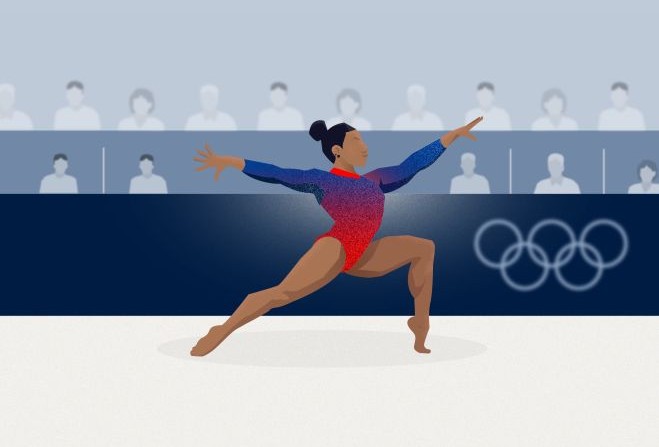
Too young to compete at the London 2012 Olympic Games, Biles burst onto the world stage in 2013. At just 16, she won two gold medals at the World Championships in Antwerp, including the coveted all-around title. She also introduced the world to a revolutionary movement on the floor exercise, her favourite apparatus: the Biles, a double layout with a half twist, now firmly part of gymnastics history.
With four gold medals at the 2014 World Championships and another four in 2015, the young phenomenon arrived at her first Olympics in Rio 2016 already formidable. Biles left no room for doubt. She won gold in the all-around, the team event, the vault and the floor exercise, as well as bronze on the balance beam. From the outset she proved herself a complete athlete, capable of mastering every apparatus in the discipline.
Simone continued to dominate gymnastics. Her extraordinary talent was once again evident at the 2019 World Championships in Stuttgart, where she won five gold medals, including the all-around title. She also amazed the judges by attempting a new vault element – the Biles II, a double backflip with three twists. To date, Biles has created five distinct elements in gymnastics: two on floor, one on beam and two on vault.
Simone Biles: mental health and gymnastics
When she arrived at the Tokyo 2020 Olympic Games, expectations surrounding her performances were enormous. At 23, Simone added two more medals to her Olympic tally, bringing the total to seven.
But in Tokyo something changed. She failed an Amanar on the vault, completing only one and a half twists instead of two, losing her balance on the landing and finishing with a disappointing result – something entirely uncharacteristic of her.
After the exercise, Biles stepped aside with her coach. Shortly afterwards her withdrawal was announced. At first it seemed she might have suffered an injury, but she later explained to the press that she had experienced what gymnasts call the “twisties” – a temporary loss of spatial awareness caused by a mental block, most often during aerial movements involving twists.
During a press conference she explained her decision to withdraw from most of the Tokyo competitions – although she still won bronze on the balance beam. She said she feared getting injured and did not want her mistakes to compromise the work of the entire team. She also mentioned how difficult it was to compete far from her loved ones, that it had been a difficult year and that she had made the decision partly for the sake of her mental health.
It marked a turning point rarely seen before. Athletes seldom speak openly about mental health, despite the immense psychological pressure they face. In fact, Biles had already revealed publicly in 2016 that she lives with ADHD (attention deficit hyperactivity disorder), writing on her personal Twitter profile: ‘’Having ADHD, and taking medicine for it is nothing to be ashamed of, nothing that I’m afraid to let people know.” In doing so, she became a powerful voice for neurodiversity empowerment.
Biles’ decision to prioritise her mental well-being sparked important conversations about the immense pressure athletes face – in gymnastics and in sport more broadly – and about the challenges surrounding mental health.
Several factors lay behind her crisis. “I didn’t have a bad performance and quit. I’ve had plenty of bad performances throughout my career and finished the competition. I simply got lost,” she declared following her withdrawal.
The COVID pandemic, which prevented her parents from travelling to support her. It was the first time they had ever missed one of her competitions.
The trauma of the sexual abuse committed by Larry Nassar, the former osteopath of the United States gymnastics team. The case became one of the largest judicial and media scandals in American sport: after being accused by hundreds of gymnasts, Nassar was sentenced to between 40 and 175 years in prison. In a public statement Simone wrote: “Most of you know me as a happy, giggly and energetic girl. But lately I’ve felt a bit broken and the more I try to shut off the voice in my head the louder it becomes.” And again: “For too long I’ve asked myself: “Was I too naive? Was it my fault? I now know the answer to those questions: No. No, it was not my fault.”
There were also the immense expectations placed upon the gymnastics phenomenon – expectations that only fuelled an already intense pressure. Criticism, moreover, had never spared her, not even when she was winning. She has spoken openly about the harsh scrutiny directed at Black gymnasts, particularly regarding appearance, in a sport whose aesthetic standards have long been shaped around white athletes. Her hair, for example, has been a constant target of criticism.
“I’m not the next Usain Bolt or Michael Phelps. I’m the first Simone Biles.”
After her withdrawal, the criticism intensified even further. Some accused her of abandoning her teammates in the team competition, others of lacking patriotism, and others still of not being a true athlete.
But Simone chose to prioritise her well-being and began attending therapy once a week. Thursdays became her therapy days – time dedicated to herself, helping her regain balance and inner peace.
The return of a gymnastics legend
In 2023, Simone returned to competition. She rebuilt herself as an athlete on new foundations after the difficult three preceding years. She did so quietly, limiting interviews and sponsorship commitments. Starting again from the basics: simple exercises on the springboard, training sessions first once a month, then twice, then once a week – gradually, over the course of a year and a half. At the World Championships, Biles won five gold medals, along with other podium finishes. She was truly back. Her vault program included the Yurchenko double pike, an element previously performed only by men. She thus became the first woman to perform it in an official competition.
Biles’ perspective on success had evolved. “I think what success means to me is a little bit different than before because before everyone defined success for me, even if I had my own narrative that I wanted. So, now, it’s just showing up, being in a good head place, having fun out there, and whatever happens, happens,” shared Biles with Olympics.com during the Antwerp championships.
Her journey continued towards the long-awaited Paris 2024 Olympic Games. At 27, Simone once again rewrote the history of artistic gymnastics, winning three more gold medals and one silver. With 11 Olympic medals, she became the second most decorated gymnast in Olympic history.
Beyond her extraordinary performances, Simone Biles will be remembered not only in artistic gymnastics but in sport as a whole for teaching the world the importance of pausing, rebuilding from within and proving that it is possible to return stronger than before.
“… We have to protect our minds and our bodies and not just go out and do what the world wants us to do.”