
Calendar
LOGO Calendar 2026 – December: Hermann Maier
Some people are born ready. Others build themselves from the ground up. Hermann Maier unquestionably belongs to the second category. Born on 7 December 1972 in Flachau, Austria, he became a legend in alpine skiing and earned a nickname that perfectly captured his character: “Herminator”.
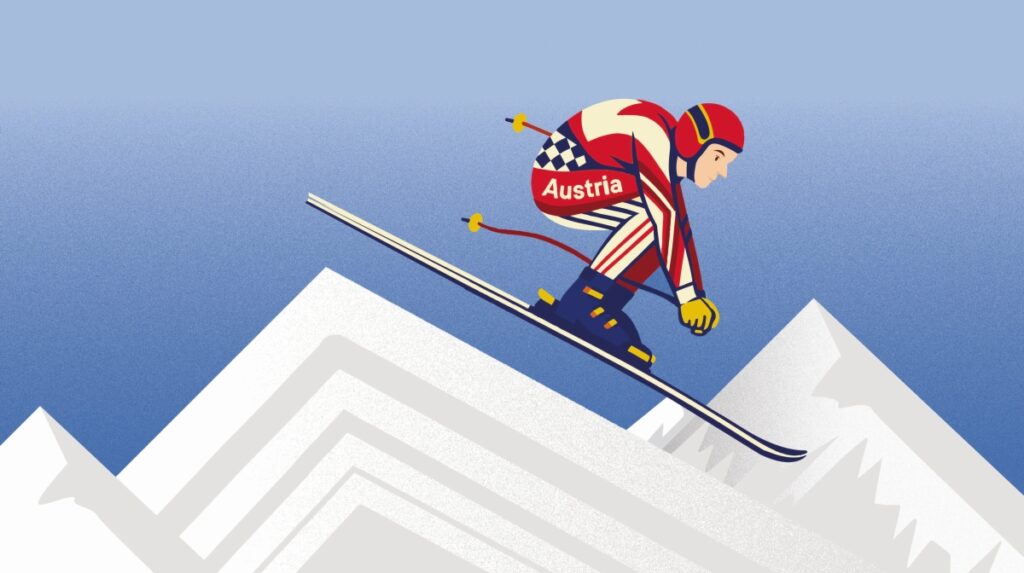
Growing up in a family of ski instructors, Maier was introduced to skiing at an early age. At 15 he joined the ski academy in Schladming, but had to leave due to growth-related problems (Osgood–Schlatter syndrome) and his extremely slight build. He returned to his hometown of Flachau, working as a bricklayer in the summer and a ski instructor in the winter, while training independently.
His World Cup debut came at the age of 23, on 10 February 1996 in Hinterstoder. His first podium followed a year later, in 1997, with a victory in the Super-G in Garmisch-Partenkirchen.
The birth of “Herminator”, the man who conquered the mountains
From the 1997–98 season onwards, his talent came into its own. During that season he won 10 races across multiple disciplines and dominated the World Cup, claiming the overall title as well as the Super-G and Giant Slalom Crystal Globes. That year is widely regarded as the turning point in his career.
By the eve of the Nagano 1998 Olympic Games, his name was already synonymous with strength and aggression, but not yet with legend. All it took was one turn to change everything.
The sky is clear, the snow perfect, and the tension palpable. The young Austrian pushes out of the start gate, a very different athlete from the skinny youngster once held back by growth problems. Maier launches down the course at full speed, as always. His skiing is powerful and aggressive, carving through turns like a razor. But 17 seconds after the start, roughly halfway down the course, at a section where the track narrows and steepens, he makes a slight mistake in his trajectory.
His skis catch a bump of ice and, travelling at over 120 km/h, the Austrian loses control.
In an instant he is launched off course, lifted into the air, his body thrown into a series of somersaults. He no longer looks like a skier, but a rag doll catapulted through the air before crashing brutally into the safety netting. The impact is terrifying. The crowd falls silent. Commentators stop speaking. The broadcast images are censored live because everyone believes they have just witnessed a tragedy.
Maier lies still for a few seconds. Then, slowly, he gets up. His suit torn, helmet dented, skis destroyed. He brushes the snow off and walks away on his own.
A shoulder and knee injury prevent him from competing in the slalom race the following day. Everything seems lost, the Olympics appear to be over for Maier.
But this is where the legend truly begins. Three days after the crash he miraculously survived, Maier was back on the slopes. Well and truly back. That day he won Olympic gold in the Super-G, and two days later he claimed another gold medal in the Giant Slalom.
An Olympic Games that began with an almost fatal accident ended with two hard-earned gold medals. From that moment, the sporting world gave him a new name: “The Herminator” – half man, half machine.
Over the course of his career he recorded 54 World Cup victories, an extraordinary number that places him among the most successful skiers of all time. He won the overall World Cup title four times (1998, 2000, 2001 and 2004). Across different seasons he also secured discipline titles in Super-G, Downhill and Giant Slalom.
In 2001, at a time when he seemed unstoppable, Maier suffered a serious motorcycle accident that forced him to miss the entire season. Despite a bleak medical prognosis, he returned to competition after 478 days, experiencing further victories, injuries and difficult moments along the way. After years of ups and downs, he eventually decided to retire from professional competition.
More than a champion: a symbol and a man
Hermann Maier did not fade into the background after retirement. He has remained a prominent public figure in Austria, taking part in events, sports projects and ski-related initiatives. He has also worked in roles connected to the world of football, including as a mental performance coach.
His two Olympic gold medals, won immediately after that dramatic crash, were not just technical victories – they were a powerful statement of mental strength.
“At that moment, while I was tumbling through the nets, I thought only one thing: ‘This is not how it’s going to end.’ I got back up. For me, the finish line had not yet arrived.”