
Calendar
LOGO Calendar 2026 – January: Eddie “The Eagle”
Eddie Edwards was the first competitor to represent Great Britain in ski jumping at the Olympic Games (Calgary Winter Olympics 1988), and his story is extraordinary.
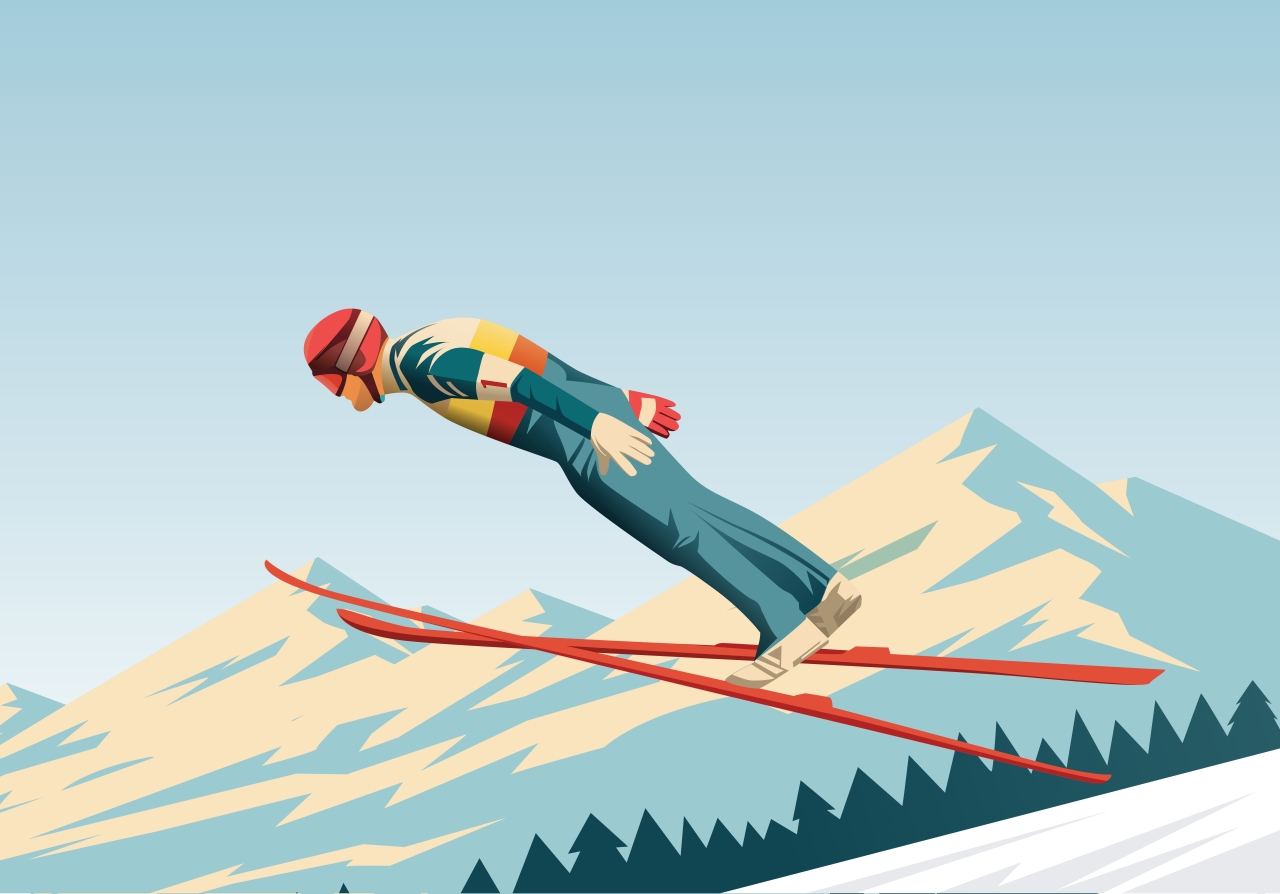
Eddie Edwards might have become a simple plasterer, like his father and many relatives before him, but he wanted more – he dreamed of going to the Olympics. In the 1980s he was one of the few English athletes practising winter sports – in England it snowed very little and there were few ski facilities.
After an injury suffered while playing football as a child, Eddie managed to become a decent downhill skier. Although he was not an outstanding talent, he entered the small circle of the English national team. There was now hope that he might fulfil his dream and compete at the 1984 Sarajevo Olympics with the alpine skiing team – but that hope was dashed when he failed to qualify.
Eddie soon realised that England was not the right place to pursue his passion for skiing, so he moved to Lake Placid in the United States to try to qualify for the 1988 Calgary Olympics. However, he soon ran out of money – the federation had no funds and skiing was far too expensive for him, the son of factory workers.
But Eddie refused to give up on his dream and came up with a bold idea – to try to qualify for the Olympics in ski jumping, a discipline in which his country had no competitors and where qualification would be less costly and less complicated. It mattered little that Eddie would have to learn a new sport in a short time, since the Calgary Olympic Games were fast approaching.
There was only one problem: Eddie was not a ski jumper.
Of course he was good on skis and had performed a few jumps in stunt demonstrations in the past – leaping over rows of cars and buses – but nothing more.
Eddie came from downhill skiing and, physically, he was too heavy for jumping. He also had poor eyesight – he wore thick prescription glasses under his ski-jumping goggles, with lenses that fogged up during performances.
He did not even have the necessary equipment, so he trained in second-hand boots that were too big, trying to compensate by wearing six pairs of socks.
Meanwhile, to make a living, he took on all kinds of jobs – gardener, cook, babysitter and cleaner – and barely managed to make ends meet.
Another issue was that ski jumping was no joke. Eddie trained on 70-metre jumps and also attempted the 90-metre hill, risking serious injury. In fact, he did get injured. While training he broke his jaw, but did not go to hospital because he had no money. Instead, he self-medicated and walked around with a pillowcase supporting his jaw.
Increasingly short of money, he ended up training in Finland, working as a house painter and living in a psychiatric hospital for one pound a night.
In total Eddie trained for two years, eventually performing up to 60 jumps a day and improving – slowly, very slowly.
The beginning was not promising: at the 1987 World Championships he finished last, but still managed to jump almost 70 metres, a distance that allowed him to meet the Olympic standard and become the first competitor to represent Great Britain in ski jumping at the Olympic Games.
Calgary 1988 made Eddie the Eagle a true star
When Eddie arrived in Calgary, fans welcomed him with a huge banner reading “Welcome Eddie the Eagle”. That was how Edwards earned his nickname. People and media around the world were fascinated by the British athlete with oversized pink ski goggles worn over his thick and comical glasses. Lacking the means even to buy skis and equipment, he used a helmet given to him by the Italians and skis donated by the Austrians.
Eddie was not remembered for his extraordinary athletic performances. If at this point you were expecting a list of medals and podium finishes, you are about to be disappointed. He finished last in both competitions – jumping 55 metres on the 70-metre hill (against the winner’s 89.5 metres) and 67 metres on the 90-metre hill, essentially half the distance of the winner, who approached 120 metres. Nevertheless, he set his personal best and the British record of 73.5 metres in one of his jumps.
And yet he is also remembered for his achievements – despite them not bringing him any medals. What greater success is there than that of an ordinary man who, through determination, manages to fulfil his dreams?
“I’d like to say I flew like an eagle, but I was probably closer to the ostrich.” (Eddie Edwards)
In many ways, Eddie perfectly embodied the idea of the founder of the modern Olympic movement, Pierre de Coubertin – that the most important thing at the Olympic Games is not winning, but taking part. Even the president of the organising committee, Frank King, mentioned Eddie during the closing ceremony:
“You have broken world records and you have established personal bests. Some of you have even soared like an eagle.” (Frank King – President of the Organising Committee)
Eddie’s Olympic adventure in ski jumping did not last long. Shortly after Calgary, the so-called “Eddie the Eagle Rule” was introduced, preventing athletes from competing at the Games unless they had previously proved themselves at World and European Championships. This rule, together with a series of injuries, prevented the Briton from qualifying for later editions of the Olympics. But the most important thing was that Eddie achieved his goal, proving that even the most extravagant and seemingly impossible dreams can sometimes become reality.