
Calendar
LOGO Calendar 2026 – April: Tamberi & Barshim
One of the most moving Olympic stories of the Tokyo Olympic Games – two athletes and their friendship, a simple combination that went straight to the hearts of sports fans all over the world.
Gimbo: Gianmarco Tamberi
Gianmarco Tamberi was born on 1 June 1992 in Civitanova Marche, the son of Marco Tamberi, a former high jumper and finalist at the Moscow 1980 Olympic Games, and the brother of Gianluca Tamberi, who later became the Italian junior record holder in the javelin throw and then an actor.
With his jumps, Gianmarco rewrote the history of Italian athletics, securing a place among the greatest of all time. His achievements include everything – Olympic champion at Tokyo 2020, European champion and world champion. An absolute champion and unique showman, at the Tokyo Games he finally made his comeback, winning the most precious medal after an ankle injury had prevented him from competing at Rio 2016. A basketball enthusiast, in 2009 he began practising athletics seriously, following in the footsteps of his father Marco – a high jump finalist at Moscow 1980 – and the results soon followed. A reflection of his personality – before the final, “Gimbo” even played the drums, just as he used to do with the band The Dark Melody, performing a classic 1970s rock repertoire.
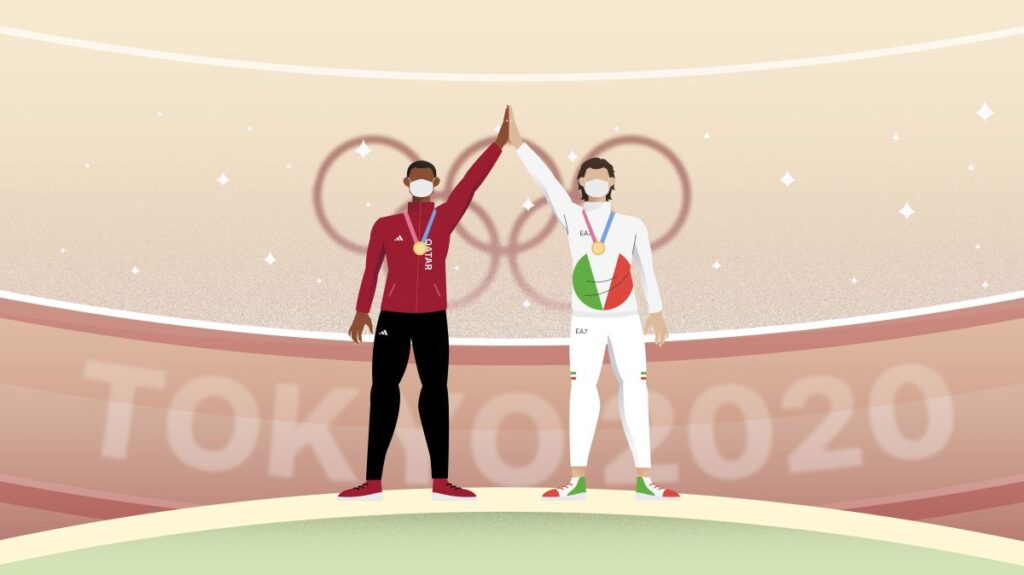
Yet the medal he earned was no ordinary one – for the first time in the history of the modern Olympic Games, two athletes shared a place on the athletics podium.
Mustaz Essa Barshim
Mutaz Essa Barshim (Doha, 24 June 1991) is a Qatari high jumper. He holds the Asian records in the discipline, with a jump of 2.43 m outdoors – the second best mark of all time – and 2.41 m indoors. During his career he has been world champion in London 2017 and Doha 2019, indoor world champion in Sopot 2014 and world junior champion in 2010. He can also boast three Olympic medals – bronze in London 2012, silver in Rio de Janeiro 2016 and gold in Tokyo 2020, shared with Gianmarco Tamberi.
The story of two gold medals and a friendship
On the most important athletics track in the world at that moment, Tamberi and Barshim began recording a series of identical results – both reached 2.37 metres. The judge approached the two jumpers and explained that they could continue the final with a jump-off. Barshim seized the moment, exchanged a knowing look with his competitor – but also friend – and asked the judge: “Can we have two golds?” And so the two athletes shared the gold medal in the men’s high jump, each choosing to forgo the jump that would have made the top step of the podium exclusive.
But the significance went beyond that single anecdote.
“We looked at each other and didn’t even think about what the right thing to do was. There was a feeling pushing us to do it. We did it,” Tamberi explained on the eve of the World Athletics Championships.
“We are great friends – we have been since 2010. I attended his wedding, and he will attend mine,” he continued. “In that moment, with a friend, there is no other decision to make, and people saw and felt that there was something real behind it. That is why everyone was so captivated by that moment – because it truly felt authentic, and that is exactly what it was for us.”
There was no shortage of criticism surrounding this choice, which many considered a clever move, seemingly at odds with the noble meaning of competitive sport, whose intrinsic spirit implies the need for a single champion. Yet despite these differing opinions, for us it proves that, at times, by setting aside pride and long-standing social and historical conventions, something truly special can be shared with others.
“This goes beyond sport,” Barshim said at the time to the Associated Press. “This is the message we send to the younger generations.”